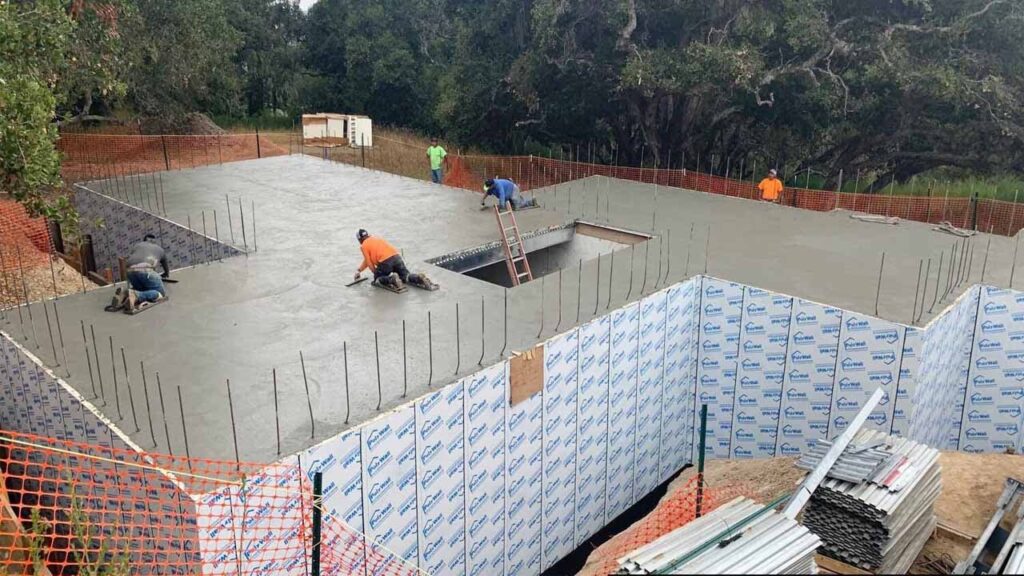
Basement building in the United Kingdom is a peculiar crossroads of ambition and frustration. It claims more room in cities where land is at a premium, though it will have to navigate some of Europe’s most complex ground conditions and regulatory environments. No place feels that tension more keenly than London, where basements are tunnelled under period houses and narrow slivers of terraced housing and streets laid out many centuries before modern engineering standards existed.
After watching basement projects throughout London, such as those undertaken by Chiswick-based firms (where properties are dense and back land is limited), we can see that technical challenges have a very real edge to them. They are physically logistical and fundamentally bound up in the character of the buildings above. Underpinning is the workhorse behind these projects, quietly shouldering both the weight of what was and what will be.
The Use of Underpinning in Basement Build Outs
Given the nature of most London basement projects, underpinning is generally not an optional extra. It’s the architectural underpinning of the whole thing. When excavating soil beneath an existing structure, the original foundation must be reinforced or extended to safely support loads.
In practice, underpinning is as much about restraint as it is strength. Rather than a new structure shoved upward, the idea is to buttress what’s already there, while enabling controlled excavation beneath. Basement construction experts in London know that what happens before the excavation process, is often the reason basements succeed or fail.
Ground Conditions and Unpredictable Soils
Ground variation is the biggest bugbear in basement building. London clay is also ubiquitous, but it’s far from homogeneous. It’s behaviour varies with humidity, seasonal travel and proximity to vegetation.
Clay shrinking and swelling, such as that caused by mature trees or historical drainage patterns, is a typical concern for basement building in Chiswick. Digging under those circumstances with no proper underpinning can cause settling, cracking or long-term instability.
The solutions start with adequate site investigation. Depending on the underpinning strategy adopted (traditional mass concrete or piled systems), trial pits, boreholes and soil analysis are drawn upon. What counts is not so much the method as how well it meets the conditions of the particular site beneath each property.
Managing Structural Loads during Excavation
Excavating under a building changes the way that loads are distributed. The walls that used to stand on solid earth must now rely on braces and temporary supports, reinforcements and new, shaky foundations.
It will solve that problem by moving the load either deeper or over a greater area of ground. But what is important here is the load transfer timing. Too abrupt a change in load, and masonry can crack. If they do not shift uniformly, distortions can result.
Basement construction specialists London crew who cut and prepare underpinning in shorter sections, releasing pressure on the structure and letting it respond more completely. This slow and deliberate approach is typically hidden from the street, but it’s what makes for a good finished basement.
Water Ingress and Groundwater Control
There is a constant threat of water when it comes to basement construction. In some regions, where the groundwater table is rather low, perched water tables and surface flows can make it hard to dig.
London clay can be very unkind if watering is not appropriately managed. It becomes soft quickly, which weakens bearing strength and leads to failure. This is something which is often needed long before a permanent waterproofing system can be installed during basement construction Chiswick projects.
Solutions to support them must acknowledge these circumstances. Mixtures of concrete, curing periods and sequence of excavation are adapted to remain stable in damp ground. It’s not so much a technology problem as one of experience-based judgment.
Working Within Tight Urban Sites
Working space in the basement construction is generally a bit tight. Access is restricted, space is confined, and neighbours are frequently no more than a few meters’ distance. This poses problems that are more than just engineering.
Foundation Pump: The selection of the foundation pump is crucial. It may not be practical to undertake the basement works with large machinery, which is why most London basement construction experts use low vibration piling rigs or hand dig methods.
There is a need to not only comply with but also maintain credibility in local communities by ensuring noise, dust and movement are controlled. A well-managed site is indicative of the understanding that construction takes place in ‘real life’ and lies not on a separate planet!
Protecting Adjoining Properties
Party wall issues affecting Basement Extensions in London. Excavations and underpinning can have repercussions for surrounding foundations, especially on terraces where the buildings are joined by shared structures.
And monitoring is crucial here. Settlement markers, crack gauges and routine monitoring enable movement to be detected when it is first experienced. Underpinning designs can sometimes move outside the basement footprint to stabilise other structures alongside.
Nowhere is this ‘thread’ through the ages more evident than in places like Chiswick, where our homes have such symbiotic relationships as they age together or because many of them share their histories and architecture. Effective basement construction in Chiswick projects will bear these in mind during design and implementation.
Regulatory Oversight and Compliance
Regulations for basement building projects are stringent. Approved work is subject to supervision from building control, planning authorities and structural engineers.
Foundation information is closely examined, especially for excavations which are deeper than normal. Temporary works layouts are just as important as the permanent ones in terms of maintaining safety during construction.
Substructure contractors, London-based and beyond, regularly advise building control, modifying techniques as the site changes. Such collaboration acknowledges that no two basement projects are ever fully identical from beginning to end.
Managing Time and Programme Pressures
Basement construction is rarely quick. The pace is determined by underpinning, curing times, inspections and the weather. Efforts to speed up these processes frequently result in problems down the road.
A measured program allows underpinning to and work its magic without pressure. ‘Concrete hardens over time and the general load-strain history of the structure changes. Expediting these steps only compromises the stability the basement is supposed to offer.
On the sites I’ve seen, the best campaigns have it cast as a technical need and not just “One of those annoying things we have to live with.
Long Term Performance and Durability
It is not the day a basement is finished that determines its quality, but how it looks in the years following. Underpinning needs to work quietly and reliably, stabilising both the existing building overhead and the new space below.
Settlement, ratcheting of moisture, and structural response go on long after there is no more building. Fine attention to detail, correct drainage and a cautious load assumption will all help ensure long term success.
One feature of many good-looking older Chiswick homes is a sensible, competently made underpinning to the basement.
Conclusion: Under London Living Skin
In London, basement construction is often positioned as a response to pressures of space, when in fact it’s more the case that the city adapts rather than cancels itself. Each basement is an accord between old buildings and modern needs.
Underpinning can be that silent mediator in this equation. It has mass, it moves, and it can change form but not collapse. The problems it solves are challenging, but the answers are based on observation, experience and respect for context.
For anyone who has stood out on London sites and seen foundations left exposed and fortified, basement construction is far more than an engineering exercise. If you hope to do things right, and if your work is done without anyone ever suspecting progress, like perfection, it starts below ground.